Curator
Karolina Maliszewska
A visual artist and independent curator. She holds degrees in graphic design and photography. Her artistic practice explores topics such as artificial intelligence, social media, and the poor image. She is a contemporary culture researcher, focusing on the digitally photographed face, its potential for fun, manipulation, oppression, and data collection.
A Shop with Faces
(Written in 2022, translated by AI)
Smartphones have been taking over the amateur photography scene for years. They're doing it so effectively that more and more companies are phasing out compact camera production, and their market has fallen by 97% over the past decade or so. New versions are no longer being designed. The sad fact is that the ones we have at home lie unused, even though they're still functional. After all, the best camera is the one you have with you, and we long ago stopped thinking about taking a compact camera with us when we go out. We don't even need a wallet; we have everything in one device. The internet is swarming with mobile photography guides. The phone, once ridiculed and used only as a last resort, has become a tool for creating advertisements and, above all, so-called "content" for social media. The speed of the internet has allowed bitmaps and even videos to be sent instead of light text. Everyone has become a creator: photographer, filmmaker. Since a device with capabilities far broader than just image recording became the tool for capturing reality, it was obvious that they would be utilized. On the one hand, we have apps that allow us to connect with the world and share our work. On the other, a number of apps that help enhance content. Add to this the opportunity to earn money by being an influencer, and you have an explosive mix. Humans are naturally lazy, so nothing ignites us like easy money.
Facebook relied heavily on words. Instagram eliminated them entirely, allowing you to create a post only after uploading an image. If you want to write something without posting a photo, you have to upload a white file instead. Over time, when all the sunsets and cups of coffee had been photographed, the camera began to be pointed in the opposite direction, at the photographer. The phenomenon is so significant that it has earned its own name: the selfie, a specific type of self-portrait. Its popularization was made possible by smartphones equipped with a second lens, on the screen side. A photograph taken at your fingertips is merciless. It reveals every imperfection, further distorting the face with a wide-angle lens. For years, we, ordinary people, have lived in a world where the media bombards us with images of perfect celebrities, whose appearance was created by the combined efforts of surgeons, makeup artists, and retouchers. All this has fueled the emergence of face-enhancing filters and entire apps that transform ordinary people into exceptional ones. In this way, we have become self-sufficient. With an average smartphone in our hands, we can become online creators based on photography. We are our own models, we can enhance photos ourselves, or alter them to our liking. To send content into the world, all we need is the internet. No one needs to legitimize us. The spiral continues. The media continues to promote an idealized world and people. We remain average. Programmers are hard at work developing new algorithms that will process images in the desired way. At the cost of losing file quality, we can painlessly change a nose that causes complexes. We can inflate our lips for free. We can tan without risking skin cancer. With a piece of glass the diameter of a pin, we can achieve bokeh equivalent to lenses weighing a kilogram.
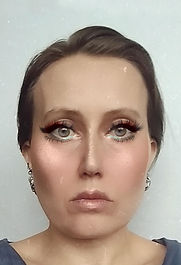
Some things emerge, only to occupy a tiny niche or disappear altogether. Then there are those that, once invented, remain forever, only changing their form. What will happen to Instagram filters? I've been observing a change for some time now. Some appear that openly mock the trend of idealizing images. More and more people are also ceasing to use them, opting for a natural look. It's still a drop in the ocean. It's not easy to give up such a wide range of possibilities. We all want to feel beautiful, and we don't always have other ways to achieve it. A separate phenomenon is the transition of digital projection into reality. People have begun to undergo surgery to appear filtered in real life. As I observe all this, the question lingers in my mind: quo vadis? What will happen next? Face generation and deepfakes are already a reality. CGI, or computer-generated imagery, supposedly enabled the recording of a new James Dean movie. Do I even think that after the wave of plastic-looking friends flooding social media, there will be, for example, a wave of digitally animated corpses wishing us happy birthday? I try not to, although I've seen 19th-century figures brought to life at exhibitions based on a single photograph, and recently, an article circulated online about artificial intelligence answering questions posed to a dead woman. Many boundaries in portrait photography have already been crossed, and the fun has barely begun. Instagram and smartphones have been around for a dozen years. Online, we can already look however we want, even changing gender and age. We can use other people's faces at our discretion, pasting them onto other figures. We can blend the features of two people to achieve a combination and, for example, see a hypothetical child of such a couple. A program can synthesize and create an average image of a group of people. We can finally create faces that don't belong to anyone, yet are so real that they don't arouse any suspicion. Although the digital world has a short history, it has already caused quite a stir and is increasingly invading real life. In the meantime, we've gained GDPR regulations designed to protect our data, and we delude ourselves that they will also protect our image. Meanwhile, the deepfake featuring President Zelensky could have led to Ukraine's capitulation. If so, another manipulation could lead to the start of a war. Our faces are no longer our exclusive property. We've lost control over them. My friend regularly receives videos from her partner in which she or he, thanks to a face-swapping app, impersonates celebrities. It's harmless fun, a few seconds of hilarious productions. However, we have no way to prevent others from using our image in this way. And what are we doing to ourselves in the meantime? We're using beauty filters excessively. Our psyche is being put to a difficult test – the confrontation of our actual appearance with our enhanced one. Unfortunately, insecurities won't disappear, and they will only deepen if, instead of learning self-acceptance, we focus on improving our physical appearance in the only area we have control over – the digital one. When my ID card was expiring in 2021, the pandemic was in full swing. So I decided to take my own ID photo without having to leave home. After all, I'm a photographer too. The ID file size is small, so I decided a smartphone photo would suffice. So I sat in front of the window with a white background behind me and took a few shots. I wasn't used to taking selfies, and until then, I'd only used my phone for taking photo notes. While taking these portraits, I thought I wanted to see how Instagram filters worked. I followed many accounts run by beautiful women, and each of them used them, which is always noted at the top of the frame. Searching for words like "beautiful" or "naturalna," I saw myself in ways I never would have imagined on my own. I often struggled to recognize myself in the photo. I took over 400 photos, changing the filter each time. The entire process took several hours, and I experienced a range of emotions. There was delight, but more often amusement at a comical appearance, or regret that I wasn't as pretty in real life. Instagram gives us a palette of masks for every mood. It's easy to lose ourselves. It's also easy to get used to a fictional appearance. As active online content creators, we become accustomed to our created image. How difficult it must be to function in real life, where we don't have such easy control over it. Because the online and offline worlds intertwine and interact, it occurred to me that filters will eventually enter our lives beyond apps. I thought about this when I saw an article about a new light printing technology. The moving image was on a material as thin as paper. If something like this is already possible today, what will be possible in the next 10, 20, or 100 years? Perhaps by refusing to accept our imperfect image, we will create a need for physical control over it. Easier and faster than plastic surgery. Not so long ago, a television was a giant box, and today we can watch movies on a watch. Over time, technology will enable us to apply a thin, clinging material to our faces, displaying a chosen image – an enhanced version of ourselves or perhaps a famous person. In this way, deepfakes will enter the real world. They will likely first appear in this form in spy movies, and after some time, they will become physically used by specialized organizations. More than one technology created by NASA has found its way into everyday life. Bond gadgets from the first films no longer impress anyone. Will we want such a product in the future? Will we choose a simpler one, requiring only a purchase, instead of the difficult path of self-acceptance? Perhaps I won't live to see humanity realize this. Perhaps it will be better for me, too.


ID photo, 2021